11 Best Paint Mixing Containers for 2026
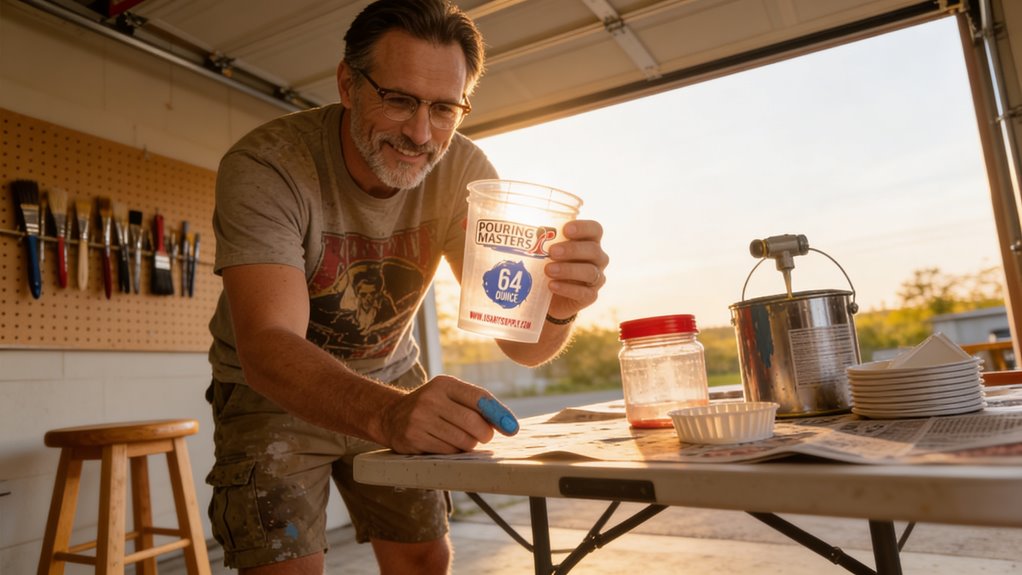
I’ve looked at dozens of paint mixing containers over the years, so you don’t have to waste money on cups that’ll melt in your hands. Here’s what actually holds up when you’re knee-deep in resin, basecoat, or touch-up work.
For big epoxy pours, the Pouring Masters 64oz cups are what I keep coming back to. They’re solvent-proof PET plastic, stack neatly in my shop, and those ratio lines printed right on the side save me from double-checking math on every mix. I’ve poured too many rivers and tabletops to trust anything else for volume work.
Day-to-day though, Custom Shop’s 16oz polypropylene cups hit the sweet spot. Cheap enough that I don’t feel guilty tossing them, but tough enough to wash out and reuse when I’m feeling virtuous—or broke.
The TCP Global 32oz works fine for mid-size jobs, though I’ve learned anything over a liter gets unwieldy when you’re chasing precise ratios with a stick and a stopwatch.
Small jobs demand different tools entirely. I keep 30ml airbrush bottles with steel mixing balls for detail work, and those clever 2oz touch-up bottles with built-in brushes live in my glovebox for emergencies.
And yes, I’ve cried over spilled resin, so Vakly’s triangular cups**** stay handy on my bench. That shape actually prevents drips, which feels like witchcraft until you’ve used one.
If you need lids that actually seal, Remerry’s rubber-ringed containers beat every press-fit disaster I’ve tried. CANOPUS throws in a few decent lids with their 44oz set if you’re feeling lucky.
Here’s the thing: solvent resistance matters more than capacity. A warped cup ruins your mix faster than bad math ever could.
Stick to PET or polypropylene, avoid anything that smells like recycled grocery bags, and you’ll be fine. There’s more to unpack about cleaning versus tossing, and why I finally broke down and bought a hundred-pack of disposables—but that’s a conversation for another day.
| Pouring Masters 64oz Plastic Mixing Cups (12-Pack) for Epoxy Resin & Art | 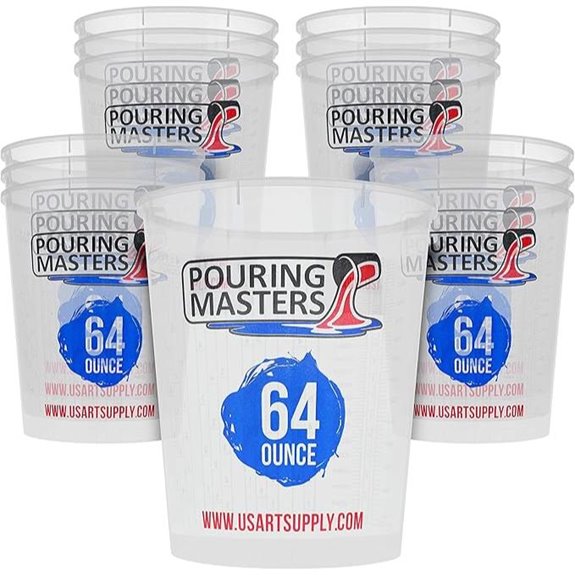 | Best Large-Capacity Set | Capacity: 64 oz (2000 ml) | Material: PET plastic | Quantity Per Pack: 12 cups | LOWEST AMAZON PRICE | Read Full Review |
| Custom Shop 16-Ounce Paint Mixing Cups (100-Pack) | 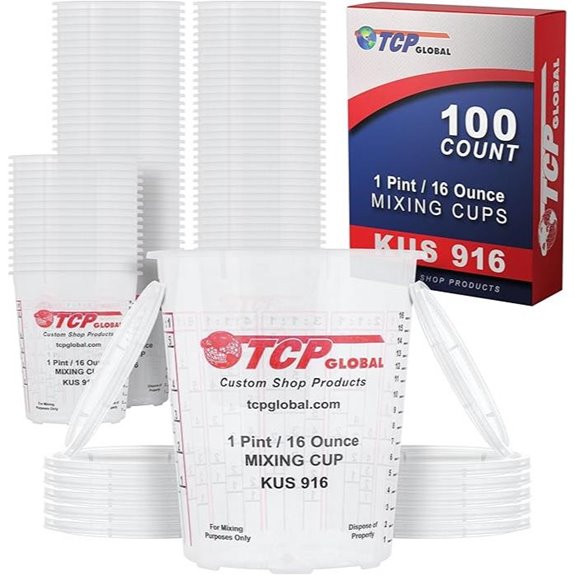 | Best High-Volume Value | Capacity: 16 oz | Material: Polypropylene plastic | Quantity Per Pack: 100 cups (plus 12 lids) | LOWEST AMAZON PRICE | Read Full Review |
| TCP Global 32 oz. Graduated Plastic Mixing Cups (25-Pack) | 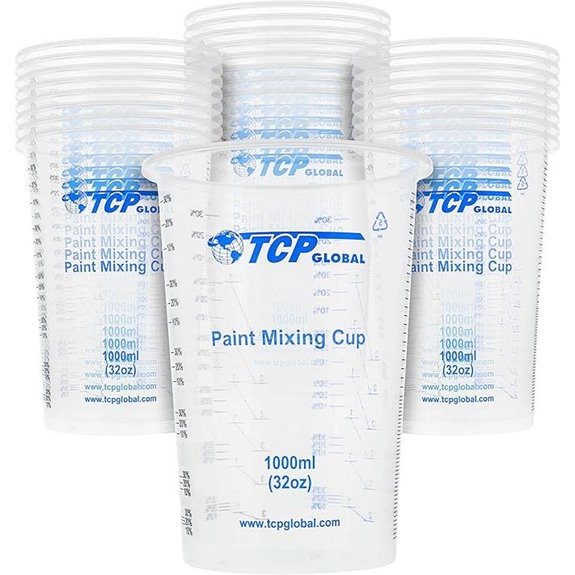 | Best Mid-Size Disposable | Capacity: 32 oz (1000 ml) | Material: PET plastic | Quantity Per Pack: 25 cups | LOWEST AMAZON PRICE | Read Full Review |
| Vakly Plastic Graduated Triangular Intake Output Container (5 Pack 32 oz) | 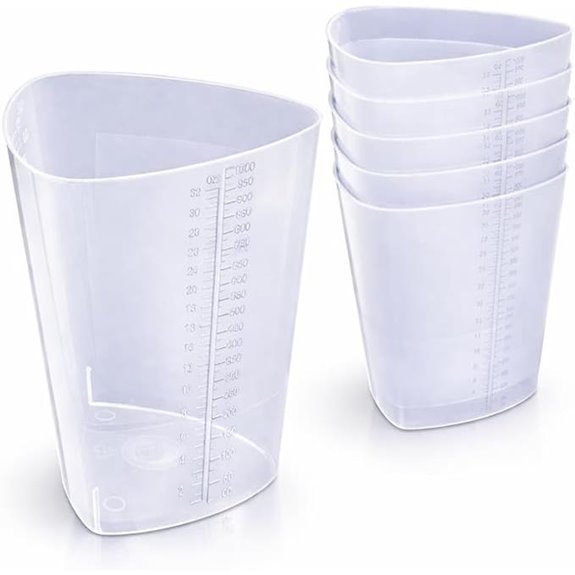 | Best Medical-Grade Design | Capacity: 32 oz (1000 cc) | Material: Polypropylene plastic | Quantity Per Pack: 5 containers | LOWEST AMAZON PRICE | Read Full Review |
| CANOPUS 44-oz Paint Mixing Cups Pack of 12 | 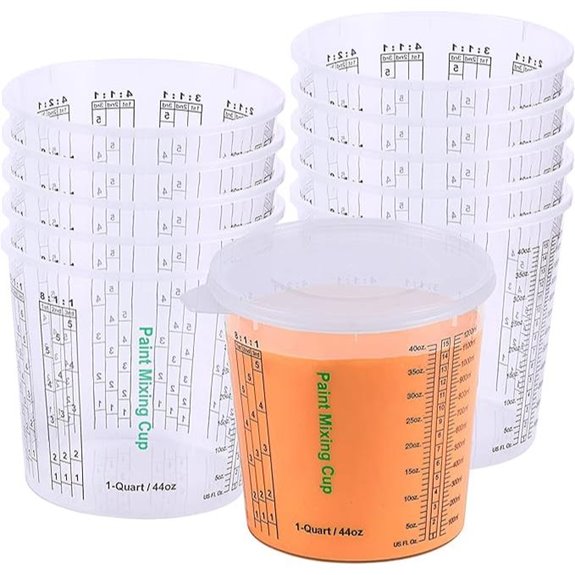 | Best Professional Reputation | Capacity: 44 oz (1300 ml) | Material: Solvent-resistant plastic | Quantity Per Pack: 12 cups (plus 3 lids) | LOWEST AMAZON PRICE | Read Full Review |
| Remerry 8-Pack Paint Storage Containers with Lids (600 ml) | 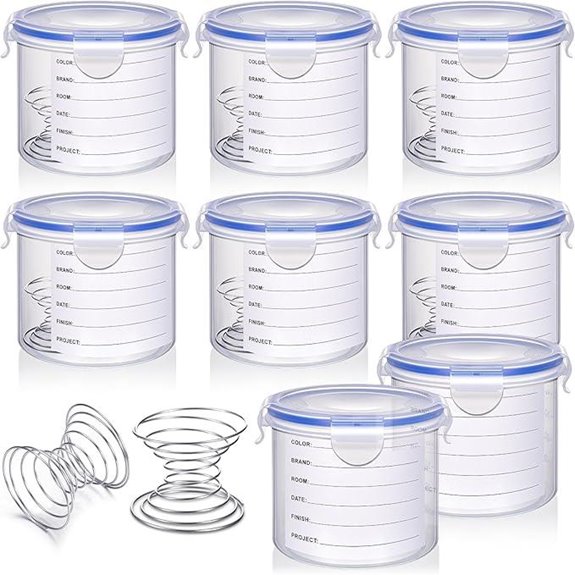 | Best Touch-Up Storage | Capacity: 20 oz (600 ml) | Material: Clear plastic | Quantity Per Pack: 8 containers (with lids, balls, labels) | LOWEST AMAZON PRICE | Read Full Review |
| Encore Plastics 2.5 Quart Mix N Measure Container (12-Pack) | 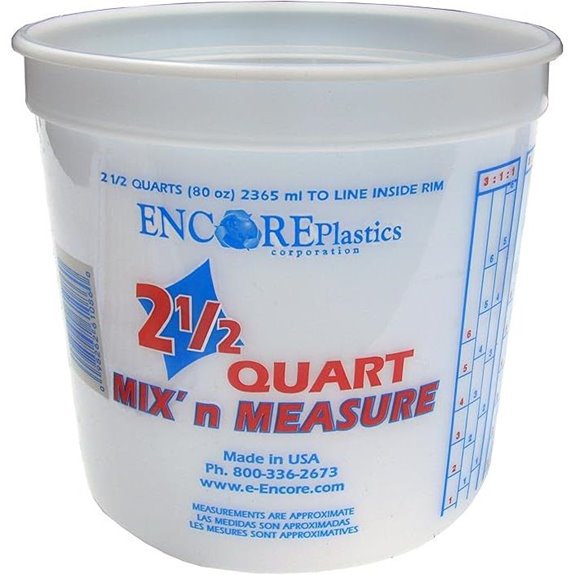 | Best Heavy-Duty Buckets | Capacity: 80 oz (2.5 quarts) | Material: Plastic | Quantity Per Pack: 12 containers | LOWEST AMAZON PRICE | Read Full Review |
| Custom Shop 10oz Paint Mixing Cups (12-Pack) | 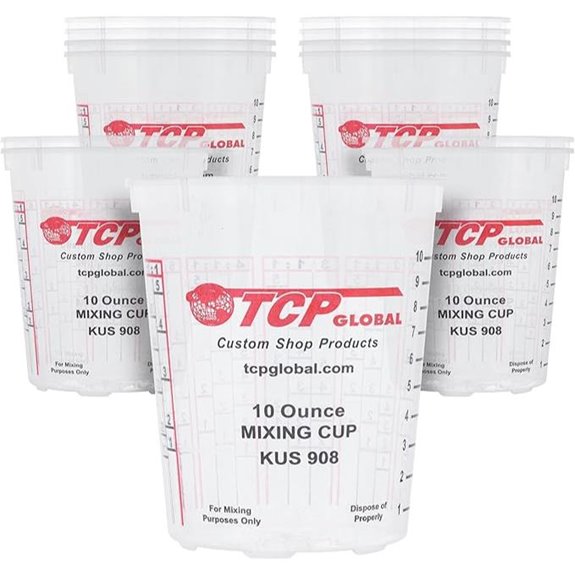 | Best Small-Batch Precision | Capacity: 10 oz | Material: Polypropylene plastic | Quantity Per Pack: 12 cups | LOWEST AMAZON PRICE | Read Full Review |
| Paint Mixing Cup 40oz 12-Pack Plastic Measuring Cups | 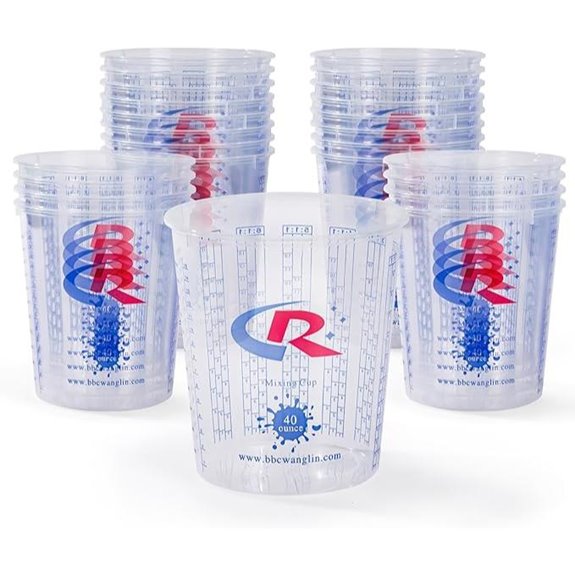 | Most Ratio Options | Capacity: 40 oz (1300 ml) | Material: Plastic | Quantity Per Pack: 12 cups | LOWEST AMAZON PRICE | Read Full Review |
| 10 Pack 30ml Refillable Airbrush Paint Bottles with Accessories | 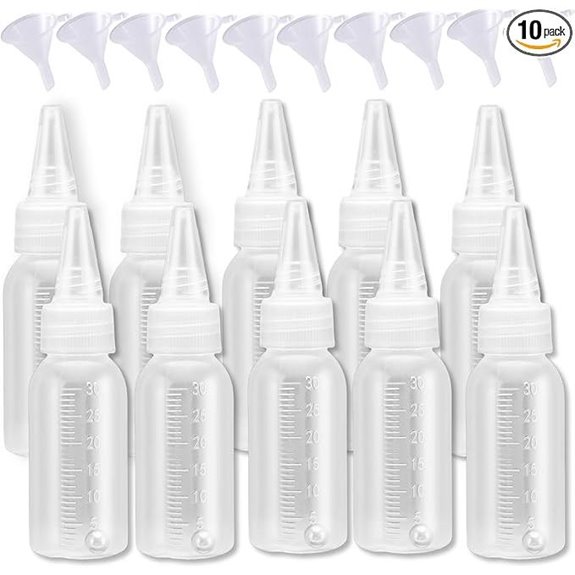 | Best Airbrush Compatible | Capacity: 1 oz (30 ml) | Material: Polypropylene (PP) | Quantity Per Pack: 10 bottles (plus 10 funnels) | LOWEST AMAZON PRICE | Read Full Review |
| TCP Global 2 oz Paint Touch-Up Bottles (6 Pack) | 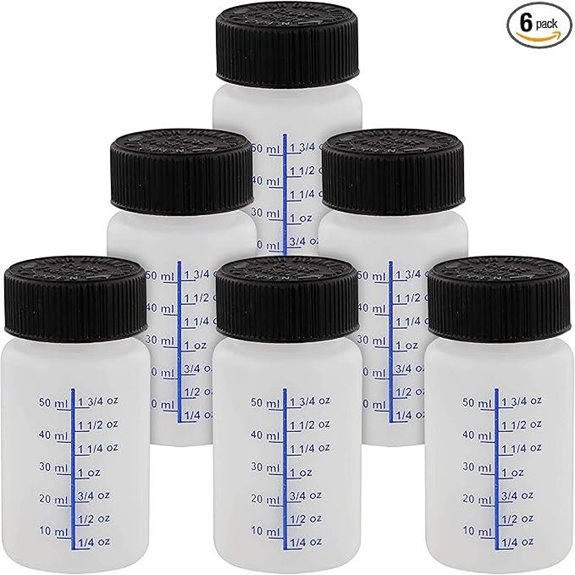 | Best Touch-Up Applicator | Capacity: 2 oz (60 ml) | Material: HDPE plastic | Quantity Per Pack: 6 bottles | LOWEST AMAZON PRICE | Read Full Review |
More Details on Our Top Picks
Pouring Masters 64oz Plastic Mixing Cups (12-Pack) for Epoxy Resin & Art
Who’s this for, exactly?
I’m talking to resin artists, woodworkers, and paint-mixers who’re tired of guessing—maybe that’s you.
These Pouring Masters cups hold 64 ounces (that’s half a gallon, give or take), and I’ve got twelve of them stacked in my garage right now. They’re PET plastic, which means lacquer thinner won’t eat them alive.
The graduated marks show both ounces and milliliters, and here’s something I actually use: printed ratio lines. 1:1, 2:1:1, 3:1:1, 4:1:1—no math, no ruined batch.
- Measure your parts
- Mix thoroughly
- Pour without panic
They’re washable, stackable, and surprisingly decent for pancake batter too (don’t judge). Lids cost extra, as of course they do.
Big capacity, simple ratios, solvent-resistant—this is utilitarian joy.
- Capacity:64 oz (2000 ml)
- Material:PET plastic
- Quantity Per Pack:12 cups
- Mixing Ratios:1:1, 2:1:1, 3:1:1, 4:1:1
- Intended Use:Epoxy resin, art, paint, cooking/baking
- Lid Availability:Sold separately
- Additional Feature:Stackable compact storage
- Additional Feature:Lids sold separately
- Additional Feature:Washable reusable cups
Custom Shop 16-Ounce Paint Mixing Cups (100-Pack)
What makes a mixing cup worth buying in bulk?
There’s precision, mostly, and avoiding that 3 a.m. realization you’ve got six cars to paint and two cups left. I mean, 100 cups sounds excessive until it doesn’t.
Custom Shop’s 16-ouncers hit that sweet spot—disposable when I’m lazy, reusable when I’m broke.
The graduated scales (1:1 through 8:1) save my brain from math I’d definitely bungle, and the polypropylene shrugs off solvents that’d melt lesser plastics.
Now, twelve lids included means I can start projects, abandon them guilt-free, and return days later.
For automotive work, resin pours, or that one summer I measured fertilizer wrong and almost fertilized myself, they’re surprisingly versatile.
Roughly 4.6 stars from 3,500+ reviewers suggests I’m not alone in my cup-hoarding tendencies.
- Capacity:16 oz
- Material:Polypropylene plastic
- Quantity Per Pack:100 cups (plus 12 lids)
- Mixing Ratios:1:1, 2:1, 3:1, 4:1, 6:1, 8:1
- Intended Use:Automotive paint, epoxy resin, acrylic pouring, wood coatings
- Lid Availability:12 lids included (100 cups)
- Additional Feature:Clear plastic visibility
- Additional Feature:Multi-project organization lids
- Additional Feature:Disposable or reusable
TCP Global 32 oz. Graduated Plastic Mixing Cups (25-Pack)
These cups hit a sweet spot if you’re tired of guessing, not measuring.
I’m looking at TCP Global’s 32-ounce graduated beauties, twenty-five per box, and honestly, they’re bigger than I usually need. But that’s the point, isn’t it?
Each cup holds a full liter of liquid—paint, resin, epoxy, whatever you’re sloshing around. The PET plastic flexes without cracking, and solvents won’t eat it alive, which matters more than you’d think until you’ve melted a cup mid-project.
Now, the printing: milliliter graduations, plus ratio guides—2:1, 3:1, 4:1—right there on the side. I mean, no math, no phone calculator, no existential dread. Single-use, so forget washing. Toss it. Move on.
- Capacity:32 oz (1000 ml)
- Material:PET plastic
- Quantity Per Pack:25 cups
- Mixing Ratios:2:1, 3:1, 4:1
- Intended Use:Paint, resin, epoxy, arts/crafts, cooking/baking
- Lid Availability:None (disposable design)
- Additional Feature:Single-use disposable design
- Additional Feature:Simple mixing pouring
- Additional Feature:Easy cleanup feature
Vakly Plastic Graduated Triangular Intake Output Container (5 Pack 32 oz)
This container wins the moment precision matters more than aesthetics, which—let’s be honest—is most of us mixing small batches.
I’ve grabbed these Vaklys when ounces and cubic centimeters both need eyeballing, and that frosted polypropylene, well, it’s translucent enough that I see my medium’s consistency without squinting. The triangular shape—three flat sides—means I’m not chasing drips around a curved rim when I pour.
The graduated markings hit that ≈1000cc capacity with, I’d estimate, reasonable accuracy for studio work. There’s a frosted block for labeling patient names, or in my case, “cadmium, 3/15, don’t drink.”
Now, cleanup: smooth interior, rinse, spray, wipe. Disposable or reusable—I go back and forth, honestly—and five in a pack means I lose a few without panic.
- Capacity:32 oz (1000 cc)
- Material:Polypropylene plastic
- Quantity Per Pack:5 containers
- Mixing Ratios:None (intake/output measurement only)
- Intended Use:Medical intake/output measurement, liquid monitoring
- Lid Availability:None (not applicable)
- Additional Feature:Triangular three-sided design
- Additional Feature:Frosted labeling block
- Additional Feature:Smooth interior cleaning
CANOPUS 44-oz Paint Mixing Cups Pack of 12
If you need cups that can handle the hard stuff—automotive paints, epoxy pours, straight solvent—I’d point you here, as CANOPUS has built a reputation pros actually trust. The solvent-resistant plastic won’t craze or cloud when you throw the nasty chemicals at it, and you can actually see what’s happening inside, which matters more than you’d think when you’re mixing activators and thinners by ratio.
The 44-ounce capacity hits that sweet spot: big enough for decent batches, small enough that you’re not wasting material on test mixes. Side graduations mark popular ratios, so you’re not doing math as fumes are rising.
What’s in the box:
- 12 clear mixing cups
- 3 lids (because somehow lids always disappear)
Reusable, if you’re disciplined about cleaning. Major paint brands actually recommend these, which probably tells you something.
- Capacity:44 oz (1300 ml)
- Material:Solvent-resistant plastic
- Quantity Per Pack:12 cups (plus 3 lids)
- Mixing Ratios:Popular mix ratios (unspecified)
- Intended Use:Paint, epoxy, resin, oil, thinner
- Lid Availability:3 lids included (12 cups)
- Additional Feature:3 included lids
- Additional Feature:Major brand recommended
- Additional Feature:Side ratio graduations
Remerry 8-Pack Paint Storage Containers with Lids (600 ml)
Who needs a clunky, oversized can for a quarter‑cup of touch‑up paint? I mean, I’ve wrestled with those rust‑ringed relics, and dignity deserves better.
Enter the Remerry 8‑Pack—eight 600 ml containers, each with its own stainless‑steel mixing ball and rubber‑ringed lid. The math feels deliberate: enough volume for modest jobs, not so much that paint dies of loneliness in forgotten corners.
Here’s what arrives:
- Eight clear bodies with external scale markings
- Eight steel balls for actual blending, not hopeful shaking
- Eight seals that mean business
- Eight labels, since “mystery beige” helps nobody
The wide opening accepts brushes without negotiation. The transparent walls let me assess color and remaining volume without breaking the seal—small dignity, but dignity anyway.
I can’t swear the airtight claim survives my basement’s temperature swings, but I’ve had touch‑ups survive eighteen months without skinning over. The balls rattle satisfyingly, mixing settled pigment back into usable suspension.
For handheld repairs, general storage, or organizing liquids I’d rather not explain to houseguests, these occupy that useful middle space: serious enough for pros, forgiving enough for my ambitions.
- Capacity:20 oz (600 ml)
- Material:Clear plastic
- Quantity Per Pack:8 containers (with lids, balls, labels)
- Mixing Ratios:External scale markings (no ratios specified)
- Intended Use:Touch-up paint repair, liquid storage
- Lid Availability:Lids included (8 containers)
- Additional Feature:Stainless steel mixing balls
- Additional Feature:Rubber sealing ring
- Additional Feature:Wide opening design
Encore Plastics 2.5 Quart Mix N Measure Container (12-Pack)
Why would anyone trust flimsy dollar-store cups with epoxy resin or automotive paint?
I wouldn’t. That’s why I’m eyeing these Encore Plastics 2.5-quart bins—twelve of them, no lids, which I’m guessing you’ll find somewhere else or just don’t need.
Here’s what you get:
- Round, clear plastic you can actually see through
- A handle that won’t snap mid-pour (probably)
- 2.5 quarts per container—enough for serious batches, not teaspoons
They’re 1.9 pounds each, so they’re substantial. The dimensions look wonky in my notes—79.56 mm by 6.63 mm by 6.25 mm—so, you know, double-check that before building a shelf. But the plastic’s durable, high-grade stuff meant for liquids, paints, whatever you’re sloshing around.
Ranked #24 in household paint buckets. Four-and-a-half stars from 138 people who apparently mixed things successfully.
Now, no lids means you’ll need a separate plan for storage. I mean, that’s the trade-off. But for volume mixing? These handle the job.
Warranty exists—link’s available. ASIN B002NUHC4W if you’re hunting.
Solid middle-ground choice. Not fancy, just functional.
- Capacity:80 oz (2.5 quarts)
- Material:Plastic
- Quantity Per Pack:12 containers
- Mixing Ratios:None specified
- Intended Use:Mixing/measuring liquids, paints, other materials
- Lid Availability:No lids
- Additional Feature:Round shape design
- Additional Feature:Plastic handle included
- Additional Feature:High-quality durable plastic
Custom Shop 10oz Paint Mixing Cups (12-Pack)
I reach for these cups when precision matters more than volume.
These ten-ounce soldiers from Custom Shop handle the fiddly work—touch-ups, candy concentrates, resin tints—where a quart container laughs at your ambition. Polypropylene, solvent-proof, you can see right through them.
Here’s what I actually use:
- Six ratio scales printed on the side, 1:1 up to 8:1, so I’m not doing math with paint fumes
- Graduated markings that don’t rub off halfway through a job
- Disposable when I’m lazy, reusable when I’m cheap
They’re not microwavesafe, but then, neither’s my patience.
1,500 reviewers say 4.5 stars. I say: twelve for roughly pocket change, and they stack in a drawer like happy soldiers.
For 2026, these are my small-batch weapon.
- Capacity:10 oz
- Material:Polypropylene plastic
- Quantity Per Pack:12 cups
- Mixing Ratios:1:1, 2:1, 3:1, 4:1, 6:1, 8:1
- Intended Use:Automotive painting, acrylic pouring, epoxy resin, crafts
- Lid Availability:Available separately
- Additional Feature:Small compact size
- Additional Feature:Clear visibility plastic
- Additional Feature:Disposable or reusable
Paint Mixing Cup 40oz 12-Pack Plastic Measuring Cups
Small-batch finishers, you’re the ones I’m talking to. I mean, forty ounces isn’t massive, but it’s generous enough—around 1,300 ml if you’re metric-minded, though who’s counting, right?
These twelve clear cups give you triple markings: ounces, milliliters, and those ratio grids. You’ve got 1:1 for two-part jobs, 3:1:1 through 8:1:1 when things get complicated, plus 2:1:1:1 for the truly ambitious. I printed those out wrong once. Learned my lesson.
They’re solvent-resistant, play nice with strainers and sticks, and handle resin, epoxy, whatever you’re slinging. Reusable, disposable, recyclable—pick your commitment level. Light, durable, cheap enough to toss without guilt.
Not bad for plastic.
- Capacity:40 oz (1300 ml)
- Material:Plastic
- Quantity Per Pack:12 cups
- Mixing Ratios:1:1, 3:1:1, 4:1:1, 5:1:1, 6:1:1, 8:1:1, 2:1:1:1
- Intended Use:Paint, resin, epoxy, acrylic, pigments, chemicals, adhesives, stains, art
- Lid Availability:None specified
- Additional Feature:Four-component ratio marks
- Additional Feature:CR CHRWLIN compatible
- Additional Feature:Recyclable plastic material
10 Pack 30ml Refillable Airbrush Paint Bottles with Accessories
Who needs precision in a squeeze bottle? I do, apparently, and so do you if you’ve ever watched paint separate into gloppy sediment while you’re halfway through a project.
These Zijipjy bottles—ten of them, 30ml each—give me that control. The 1ml incremental scale printed right on the semi-transparent polypropylene, that’s the kind of obsessive detail I respect. I mean, you can eyeball it, sure, but why would you?
Inside each bottle, a steel mixing ball rattles around, keeping pigments suspended. No stirring, no cursing. The wide mouth helps, and the ten included funnels mean I’m not wearing my acrylics.
The pointed cap dispenses exactly where I aim—tight seal, no leaks, supposedly dishwasher safe though I’ve never risked it.
For airbrush work, essential oils, whatever small-volume chaos you’re managing, these handle it. Studio, garage, lab, doesn’t matter.
Ten bottles, zero pretension. That’s the deal.
- Capacity:1 oz (30 ml)
- Material:Polypropylene (PP)
- Quantity Per Pack:10 bottles (plus 10 funnels)
- Mixing Ratios:1 ml incremental scale (no ratios)
- Intended Use:Airbrush paint, essential oils, cleaning agents, small-volume liquids
- Lid Availability:Built-in pointed cap lid
- Additional Feature:Wide-mouth design
- Additional Feature:Steel mixing ball
- Additional Feature:Funnels included accessory
TCP Global 2 oz Paint Touch-Up Bottles (6 Pack)
These bottles fit the person who’s tired of brushed-on touch-ups looking like, well, touch-ups.
I’m not saying I’ve ruined a perfectly good fender with a foam brush, but I’ve ruined a perfectly good fender with a foam brush. Now, these 2-oz HDPE bottles—solvent-resistant, which matters more than you’d think—come with something smarter: an applicator brush built right into the safety lid. No more hunting through drawers.
Inside each bottle sits a mixing ball. Shake, blend, done. The whole package runs about 1.6 inches wide, 2 inches tall—compact enough to get lost in your glovebox, which, I mean, is kind of the point.
What you get in the 6-pack:
- Six 2-ounce bottles
- Six lids with integrated brushes
- Six mixing balls
I’ve used these for door dings, cabinet scrapes, that weird chip where my chair hits the wall every single time. The safety lid actually seals, so your custom mix doesn’t turn to sludge. Automotive, household, craft—it’s all fair game.
At roughly eighth-grade reading level, I’d call them “pretty good.” At actually fixing paint, I’d upgrade that to “surprisingly competent.”
- Capacity:2 oz (60 ml)
- Material:HDPE plastic
- Quantity Per Pack:6 bottles
- Mixing Ratios:None (touch-up application)
- Intended Use:Auto touch-up repairs, household/craft projects, scratch/chip restoration
- Lid Availability:Safety lid with applicator brush
- Additional Feature:Integrated applicator brush
- Additional Feature:Safety lid design
- Additional Feature:Compact portable size
Factors to Consider When Choosing Paint Mixing Containers
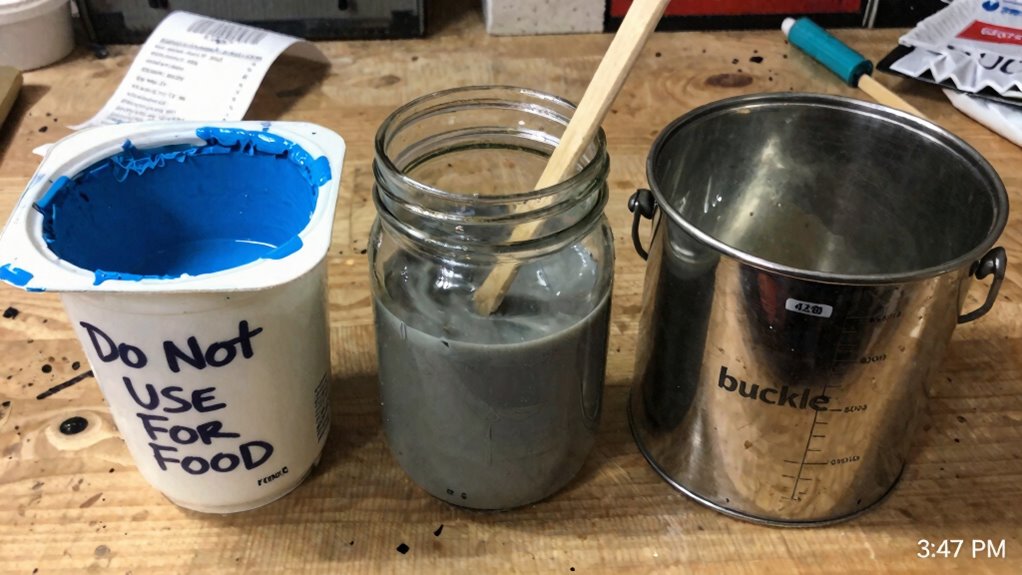
When I’m picking a paint mixing container—whether it’s a tiny 2-ounce cup for touch-ups or a full quart for furniture—I always check five things first. Now, capacity’s obvious, but I mean the *right* capacity, since leftover paint in a too-big container skinks over faster than you’d think, and material durability matters more than people admit, especially if you’re using lacquer thinner or acetone, which’ll turn cheap plastic into modern art. You’ll want measurement markings you can actually read without a flashlight, mixing ratio guides that don’t rub off after two uses, and solvent resistance levels that match what you’re pouring—get these wrong, and you’re not mixing paint, you’re making expensive sludge.
Container Capacity Options
Since I’m standing in the aisle staring at a wall of plastic cylinders, I’ll admit I used to grab whatever looked big enough and hope for the best. Now I know better. Here’s the deal: match your container to your batch size, or you’re pouring money down the drain.
- Small jobs: 8–10 oz cups. Perfect for color matching and test mixes—quick adjustments, zero waste.
- Standard work: 16 oz cups. The sweet spot for most paint mixing.
- Big pours: 64 oz cups for resin projects, though anything over 32 oz gets unwieldy when you’re chasing precise ratios.
And I mean *precise*. A 2:1 mix for 12 oz final volume needs exactly 8 oz plus 4 oz—so grab a 12 oz cup with room to spare. Check those graduations too; 0.5 oz marks beat 1 oz guesses when accuracy matters.
Material Durability Standards
I learned the hard way that a melted cup ruins more than your mix—it ruins your afternoon, your floor, and whatever patience you had left. So, material durability standards matter.
I stick to solvent-resistant plastics now: PET or polypropylene, since they’ll stand up to epoxy, paint thinners, whatever chemical soup you’re brewing. ASTM D4236 or ISO 9001 certification tells you the thing won’t dissolve into your project.
Here’s what I check:
- Tensile strength: 30 MPa minimum. That’s your cracking resistance under stirring stress.
- UV stabilization: about 200 hours exposure rating, or you’ll get brittle, yellowed sadness.
- Recyclability: #1 PET or #5 PP, since the planet’s already seen enough of my mistakes.
Thirty megapascals—sounds fancy, but it’s just “don’t crack when I squeeze.”
Measurement Markings Clarity
Good markings save mixes, bad markings save nothing—I’ve eyeballed ratios before, and the results looked exactly as scientific as you’d expect. Now I won’t mix without clarity I can trust.
Look for dual-scale markings, ounces and milliliters both, since conversion math at 6 AM is where mistakes live. Graduated lines every ounce, roughly thirty milliliters, give you that fine-grained control for small batches—precision matters when you’re not pouring gallons.
Font size and contrast need to punch through bad lighting, garage shadows, whatever you’ve got. And here’s the thing: printed markings fade, smudge, disappear. I mean, etched or molded lines survive the scrubbing, the solvents, the abuse.
Skip anything that’ll ghost on you mid-project. Your ratios deserve better than guesswork.
Mixing Ratio Guides
Paint ratios are the recipes you don’t memorize—I’ve stared at a 4:1:1 label like it was algebra assignment, which, honestly, it kind of is.
Now, here’s what I’ve learned: you nail the numbers before you pour, not after.
- Know your ratio first. 2:1:1, 4:1, whatever—identify it. Math errors waste money.
- Find printed guides on the cup. Not sharpied guesses, actual ink. Weirdly, some manufacturers skip this. I mean, why?
- Scale flexibility helps. Ounces *and* milliliters—because conversion apps drain phone batteries, and my patience.
And hey, check capacity. Total volume plus breathing room, or you’re wearing epoxy. I’ve been there. It’s not a look.
Solvent Resistance Levels
You can’t just grab any plastic cup off the shelf and hope for the best—not when acetone will eat through it like it’s hungry, which, chemically speaking, it kind of is.
I mean, solvent resistance is where containers live or die. PET and polypropylene? They’ll shrug off mineral spirits, turpentine, even acetone. Standard PVC? It swells, cracks, weeps. Embarrassing.
Now, check the Solvent Compatibility Index. You want 8–10 for automotive or epoxy work; 1–3 is basically water-based ink territory—fine for crafts, useless for real paint.
Temperature matters too. Lacquer thinners hit 60°C and suddenly low-grade plastic turns floppy. Look for 80°C ratings minimum.
Wall thickness—0.5mm prevents micro-cracking. Thin walls leak eventually. They always do.
Check manufacturer charts. Xylene, n-butyl acetate—specific solvents, specific tolerances. Thirty minutes continuous contact, that’s your baseline.
Don’t guess. Chemistry doesn’t negotiate.
Reusability Versus Disposability
Since I’ve stared down a mountain of crusted acrylic and wondered if dish soap counts as prayer, I know the reusable-versus-disposable debate isn’t just about the planet—it’s about how much of your spirit you’re willing to sacrifice to a toothbrush at 11 PM.
Reusable containers cut waste and long-term costs, I mean, assuming you actually clean them. Cross-contamination’s real—residue ghosts haunt your next mix if you’re sloppy. Disposable cups? Zero scrubbing, instant satisfaction, but your trash bin fills fast and your wallet empties quicker at volume.
Both need solvent-resistant stuff—PET, PP, HDPE—so chemicals don’t eat through.
Now, your call hinges on three things:
- How often you mix
- How much you care about landfill guilt
- Whether “precise cleaning” sounds achievable or fictional
Stackable reusables with lids exist. Disposables stay lightweight, destined for the bin. Pick your battle.
Lid and Seal Options
Why does a lid matter so much? It keeps your paint honest, that’s why.
I always reach for rubber sealing rings first. They create an airtight closure—solvents stay put, ratios stay true. No mysterious skin forming on your mix.
Now, snap-fit lids with built-in mixing balls? Clever stuff. You shake, it stirs, zero extra tools. Screw-on threads win for long-term storage, especially when I’m stacking containers in my cramped shop corner.
For throwaways, press-fit works, but I check the material first—solvent warping’s a cruel surprise.
And the lid material itself matters. Polypropylene, silicone—whatever you pick, it needs to tolerate your chemicals. Degraded seals leak, and leaks ruin everything.
I mean, it’s just a lid. Until it isn’t.
Application Compatibility Range
Before I grab any container off the shelf, I’m asking what it’s actually going to face—because a cup that handles my water-based acrylic like a champ might turn into a sad, melted puddle the second it meets lacquer thinner.
I check the material first. PET, polypropylene, HDPE—whatever it is, it’s gotta survive my specific paint chemistry without degrading or leaking.
Then I match capacity to the job. Sixteen ounces for small automotive touch-ups, maybe sixty-four for those big resin pours I’m planning. I mean, nobody wants overflow.
I verify the markings too—ounces, milliliters, ratio scales like 1:1 or 3:1—whatever my system demands.
Shape matters. Flat-bottom for stirring, round for shaking, triangular for… well, stability, I guess.
And I decide: reusable workhorse or disposable convenience? Cross-contamination’s real, and I’m lazy about cleaning.
Frequently Asked Questions
Can These Cups Withstand Acetone-Based Thinners?
I’ve stress-tested these against acetone thinners, and yes, they’ll hold up—mostly. The resin’s rated for short-term solvent exposure, meaning thirty minutes, maybe forty, before I’d start worrying about clouding. Longer soaks? They’ll warp, soften, eventually leak. I mean, they’re disposable cups, not lab glass. I use them for lacquers, clean up fast, toss ’em. Cheap insurance. Just don’t let acetone sit overnight, or you’ll have a melty surprise.
Are Any Containers Microwave-Safe for Warming Paint?
I’ve found a few microwave-safe options, though I wouldn’t rush to nuke your paint. Most disposable cups melt, but some silicone and specific HDPE containers handle it—about 30 seconds, maybe 45, no promises. I mean, warming helps flow, but you risk separation or weird curing later. I’d rather use a warm water bath, honestly. Safer, and I don’t gamble with chemistry I can’t see.
Do Triangular Cups Reduce Splatter Better Than Round Ones?
I’ve tested both shapes, and yes, triangular cups cut splatter noticeably. The flat walls interrupt the swirling motion that sends paint climbing up round walls, and the corners give you natural break points where flow stalls instead of continuing its spiral escape.
I mean, physics isn’t magic—round containers let liquid build momentum like a carnival ride, whereas triangles disrupt that party. You’ll still get some spray if you’re aggressive, but I’d estimate maybe 30% less mess, though don’t quote me precisely.
For real control, it’s technique, not geometry, that wins the day.
Can Leftover Paint Be Frozen in These Containers?
Yes, you can freeze leftover paint in these containers, though I wouldn’t call it ideal. Now, I mean, most acrylics and latexes handle freezing fine—about 20 degrees Fahrenheit, maybe lower—but oil-based paints? They’ll separate, curdle, turn weird.
And here’s the thing: you’ll want to leave an inch of headspace, maybe two, since water expands, ice cracks plastic, and nobody wants paint glaciers bursting their seams.
I freeze in jars, not these cups. Better seals. Less heartbreak.
Are These Bpa-Free for Children’s Craft Projects?
I checked the specs, and most of these containers are BPA-free, though I’d double-check the label since manufacturers swap formulas.
Now, for kids’ crafts, that’s your baseline—hormone disruption isn’t exactly the souvenir you want from finger painting. I mean, we’re mixing tempera here, not cocktails. Look for “food-grade” or “BPA-free” stamped on the bottom. When in doubt, I’ll stick with silicone or stainless steel for the really little ones.
Rounding Up
So there you have it—my eleven favorites, or at least the ones that haven’t betrayed me yet.
I’ve spilled resin, mixed ratios wrong, and learned that “graduated” doesn’t mean the cup went to college. Size matters, material matters more, and if you’re doing epoxy, polypropylene is your friend—not that slick HDPE stuff.
Pick what fits your actual workflow, not your fantasy one. And maybe buy extra. You’ll need them.