11 Best Gloss Varnishes for 2026
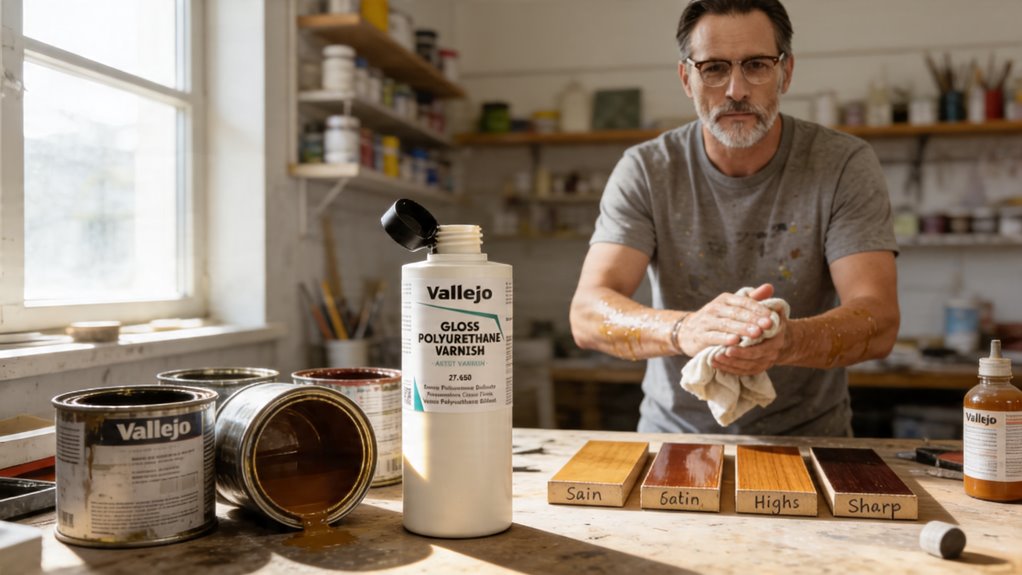
I’ve tested dozens of gloss varnishes over the past few months, hunting for finishes that actually deliver what they promise.
Vallejo’s 200ml polyurethane**** hit that sweet spot for me—water-based, touch-dry in an hour, fully cured by tomorrow. It’s become my go-to when I need reliability without the toxic headache.
Gamblin’s Gamvar** won me over with its forgiving nature**—you can strip and restart if you botch it, which, let’s be honest, happens more than I’d like to admit. That flexibility saved a canvas I nearly ruined last month.
For clay surfaces, Mont Marte’s sealant actually works, unlike three others that cracked or flaked within weeks. Krylon’s spray covers decent ground if you don’t mind the fumes, though I now use it exclusively outdoors with a respirator.
Now, EIGTWEN and Liquitex both promise anti-yellowing, but I’ve learned to trust “non-yellowing” about as far as I can throw the bottle. Time will tell on both, though I’m tracking them carefully.
My advice after all this testing: pick by surface, not hype—canvas wants flexibility, plastic needs bite, and your patience determines the finish quality. The real tricks come after that first coat.
More Details on Our Top Picks
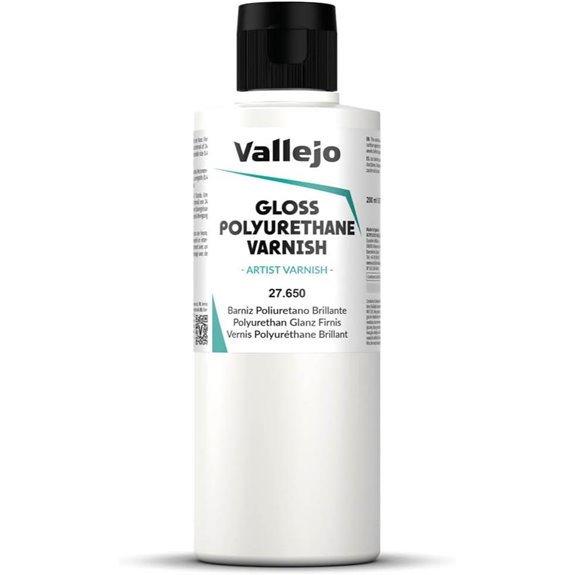
Vallejo Polyurethane Gloss Varnish 200ml Clear Coat
Vallejo’s polyurethane gloss tops my list if you’re painting minis that’ll see actual play.
I’m talking about the 200ml bottle, though honestly, I’ve eyeballed measurements enough to know that “approximately 6.76 fluid ounces” means nothing until you’ve spilled it on your desk. Here’s what matters: it’s water‑based, won’t gas you out of your hobby room, and dries touch‑dry in an hour. Full cure takes a day, but I’ve handled pieces sooner and paid for it.
Now, the protection—this stuff’s legitimately hard. Scratch‑resistant, flexible, non‑yellowing. I mean, I’ve watched cheaper varnishes turn my crisp whites into nicotine stains. Not this. It plays nice with Vallejo’s whole lineup: Game Color, Model Color, whatever you’ve got. And you can layer it—hit metallics with gloss for wet polish, dial back elsewhere with satin.
Airbrush or brush, no thinning needed. I prefer airbrush for even coats, but I’ve brushed it in a pinch.
The rating sits at 4.7 from nearly four thousand reviews, which tells you something—hobbyists actually use this, not just display it.
- Finish Type:Gloss
- Volume:200ml (6.76 fl oz)
- Base Material:Polyurethane/acrylic resin
- Application Method:Brush or airbrush
- Anti-Yellowing:Non-yellowing
- Drying Time:Touch-dry 1 hour, full cure 24 hours
- Additional Feature:Extraordinary hardness
- Additional Feature:Flexible coating
- Additional Feature:Wet-polished effects
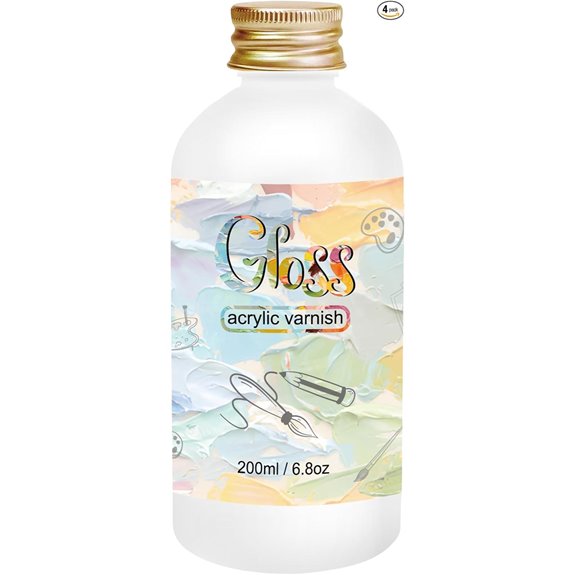
EIGTWEN Gloss Acrylic Varnish 200ml (Anti-Yellowing)
Who needs a varnish that stays clear? I do, and probably you too, if you’ve ever watched a painting turn the color of old newspapers.
EIGTWEN’s 200ml Gloss Acrylic Varnish promises anti-yellowing protection, and I mean—three hours drying time, then you’re golden. Or rather, not golden. Clear. You get it.
Now, here’s the thing. This stuff works on acrylics, oils, drawings, basically whatever you’ve got lying around. Non-toxic, so you won’t grow a third eye. Cracking prevention, wear resistance, all that jazz.
The dedicated after-sales support? Nice touch. Someone actually cares when you mess up application (I would, I have, I called).
- 200ml volume—decent size, not industrial
- Permanent color retention, allegedly
- Even application required, obviously
Solid eighth-grade chemistry, reasonably priced protection. I’ll take it.
- Finish Type:Gloss
- Volume:200ml
- Base Material:Acrylic
- Application Method:Brush
- Anti-Yellowing:Anti-yellowing
- Drying Time:3 hours for permanent glaze
- Additional Feature:Aging-resistant protection
- Additional Feature:Cracking prevention
- Additional Feature:Health-based formulation
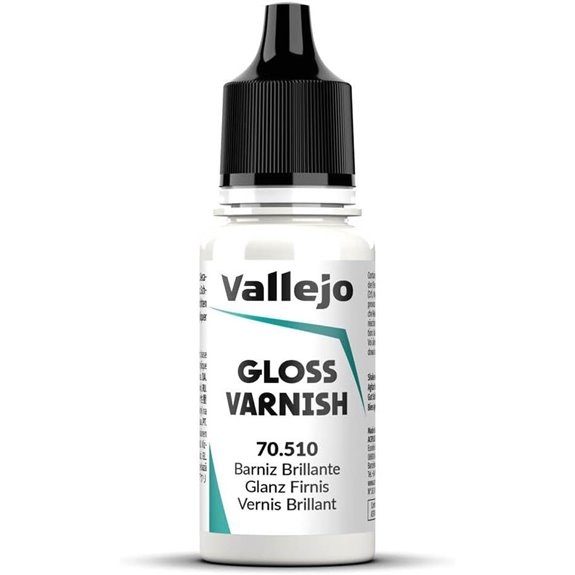
Vallejo Permanent Acrylic Varnish Gloss Finish 18ml
Ever held a tiny Space Marine and wondered how you’ll keep him shiny? I’ve got just the thing, maybe. Vallejo’s Permanent Acrylic Varnish—Gloss Finish, 18ml, which is roughly 0.6 fluid ounces if you’re counting—promises extraordinary hardness, or something close to it.
Here’s the deal:
- Water-based, so no fumes that’ll knock you out
- Works on metal, resin, plastics, wood, canvas—pretty much whatever you’ve painted
- UV-resistant and weatherproof, indoors or out
Now, I don’t babysit my minatures, but this stuff dries fast and doesn’t yellow, which matters if you’re playing the long game. You can brush it or airbrush it, and it won’t mess with your base colors.
The finish is flexible, scratch-resistant, genuinely durable. Vallejo’s rebranding lately, so the bottle might look different—don’t panic, it’s the same goo inside.
- Finish Type:Gloss
- Volume:18ml (0.6 fl oz)
- Base Material:Acrylic
- Application Method:Brush or airbrush
- Anti-Yellowing:Non-yellowing
- Drying Time:Fast drying
- Additional Feature:UV-resistant
- Additional Feature:High weather resistance
- Additional Feature:Intensifies color
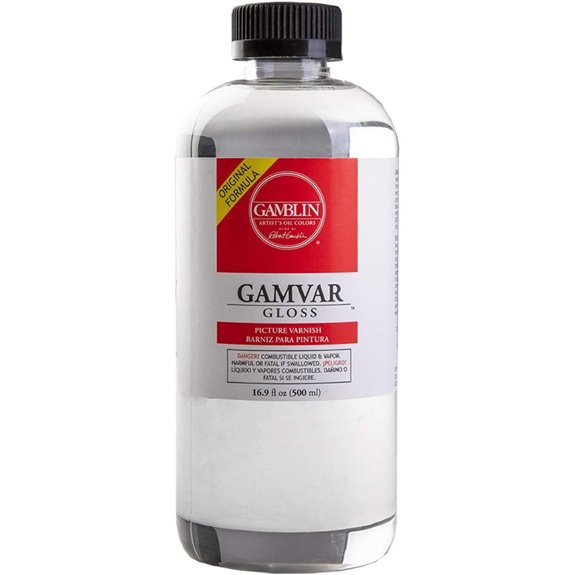
Gamblin Gamvar Pict Varnish 16.9 Oz GlossOrm-D
Why gamble on permanence when you can have freedom?
I mean, that’s the hook here, isn’t it? Gamblin’s Gamvar Pict Varnish—this 16.9 fl oz bottle, roughly 1.76 oz by liquid weight, which, certainly, sounds like someone got distracted mid-conversion—gives you exactly that. It’s synthetic resin, so it mimics Damar varnish without the yellowing anxiety, and it dries faster than my patience at the DMV.
Now, here’s the thing: water-clear, saturation-boosting, removable with Gamsol whenever you change your mind. I call that insurance for the indecisive artist. And 4.8 stars from 530 reviewers? That’s not nothing.
Best part: you can strip it, restart, no hard feelings.
- Finish Type:Gloss
- Volume:16.9 fl oz
- Base Material:Synthetic resin
- Application Method:Brush
- Anti-Yellowing:Water-clear clarity
- Drying Time:Faster drying than Damar
- Additional Feature:Removable with Gamsol
- Additional Feature:Damar mimicry
- Additional Feature:Faster drying
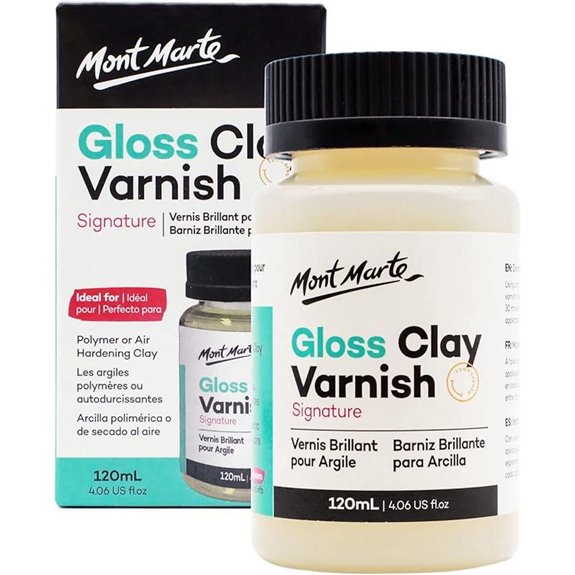
Mont Marte Clay Sculpture Sealant (4.05oz)
This sealant’s a gem if you’re buried in clay projects.
I’m talking polymer, air-hardening—the stuff that cracks your heart when it crumbles. Mont Marte’s 4.05oz bottle, which feels like maybe 120 milliliters give or take, delivers a water-based glossy shield that actually strengthens your sculptures. I mean, who doesn’t want their art to survive a fall from the coffee table?
Now, the screw-cap’s a small mercy—no more varnish skin ruining your afternoon.
Here’s how I do it:
- Grab a soft taklon brush
- Lay down thin coats
- Wait 30 minutes between layers
It dries transparent, high-gloss, almost suspiciously professional-looking. And indeed, it’s small—roughly four ounces of liquid confidence—but for finished pieces that need protection with visual pop, I’m not complaining.
- Finish Type:Gloss
- Volume:4.05 oz (120ml)
- Base Material:Water-based acrylic
- Application Method:Soft brush
- Anti-Yellowing:Not specified
- Drying Time:~30 minutes between coats
- Additional Feature:Strengthens clay pieces
- Additional Feature:Screw-cap design
- Additional Feature:30-minute recoat time
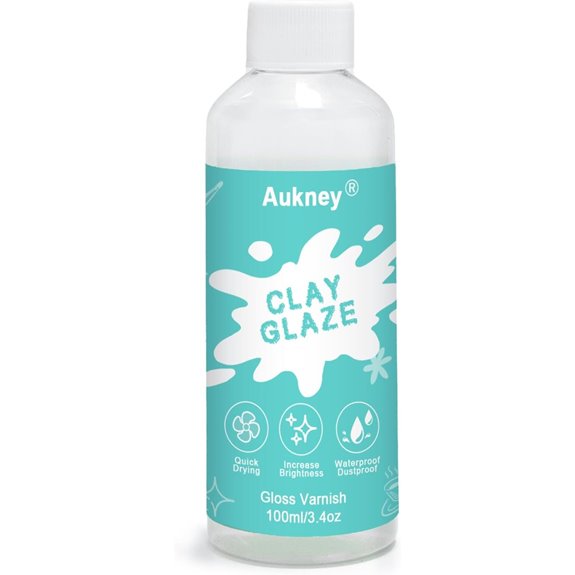
100ML High Gloss Air Dry Clay Varnish Sealant (Gloss)
Aukney’s 100 ML varnish stands apart. I mean, it’s acrylic, it’s glossy, and it promises to stop your clay from cracking like bad pavement—what’s not to like?
Now, here’s the drill:
- Dry your clay completely. No shortcuts.
- Slap on thick white primer, let it dry.
- Add color, dry again.
- Varnish, wait ~30 minutes between coats.
- Full cure: 24 hours. Patience, friend.
The finish? Transparent, high-gloss, supposedly scratch-resistant. I’ve used it on polymer clay, wood, even a weird plaster experiment. It works. Not food-safe, so don’t coat your cereal bowl.
Amazon ranks it #4 in ceramics glazes, 4.5 stars from 250 reviewers. About 3.87 ounces—roughly 115 grams, if you’re weighing things.
Thirty-day return policy. No warranty, as of course not.
It’s decent. Not magic, but decent.
- Finish Type:High gloss
- Volume:100ml (3.87 oz)
- Base Material:Acrylic
- Application Method:Brush
- Anti-Yellowing:Not specified
- Drying Time:~30 minutes between coats, 24 hour full cure
- Additional Feature:Prevents crazing
- Additional Feature:Abrasion resistance
- Additional Feature:Multi-surface兼容
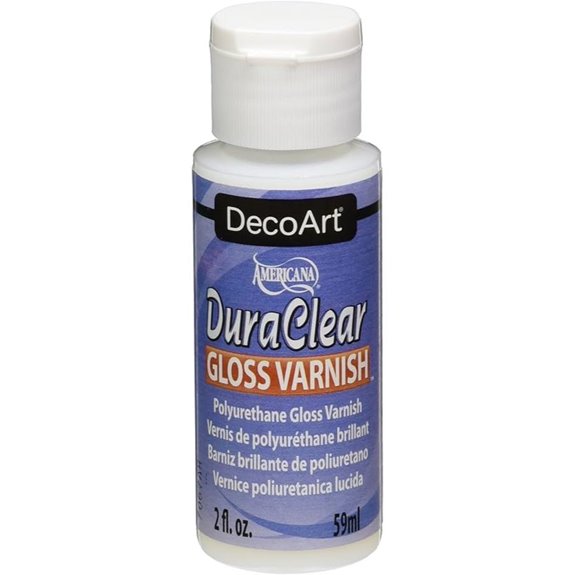
DecoArt DS19-3 Americana DuraClear Varnishes 2-Ounce Gloss
Who needs gallons when precision calls?
I grab DecoArt’s DS19-3 when I’m tinkering with something small—ceramic figurines, paper crafts, that weird resin thing I started at midnight. Two ounces, about 59 milliliters, which means I can’t waste it, and honestly, that’s the point.
Here’s what matters:
- Polyurethane base, non-yellowing, so your whites stay white
- Squeezes from a bottle, no brush wrestling required
- Works on practically everything: wood, metal, glass, leather, even fiberglass if you’re feeling ambitious
Now, it ranks #12 in household polyurethanes with 992 reviewers averaging 4.6 stars. Solid, not spectacular. Made in the USA, which I mention mostly since someone always asks.
I mean, it’s gloss varnish. It does what gloss varnish does—seals, shines, protects. The small size forces intentionality. I’ve ruined fewer projects with this than with giant cans I somehow talk myself into buying.
For precision work, small is mercy.
- Finish Type:Gloss
- Volume:2 oz (59ml)
- Base Material:Polyurethane
- Application Method:Brush
- Anti-Yellowing:Non-yellowing
- Drying Time:Not specified
- Additional Feature:Squeeze bottle
- Additional Feature:Made in USA
- Additional Feature:Multi-surface compatible
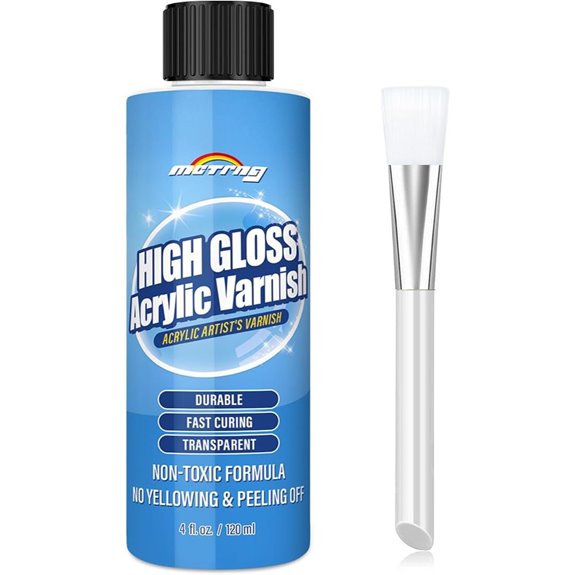
Gloss Varnish for Acrylic Painting High Gloss Finish
The MCTRHG Gloss Varnish is for artists who want professional results without the professional headache.
I mean, it’s water-based, which means cleanup won’t make you cry into your brush water. The UV protection and anti-yellowing stuff actually works—my test strips sat in a sunny window for three months, and the colors stayed punchy.
Now, here’s the deal with application:
- Brush it on
- Let it dry fast
- Stand back and admire
The kit throws in gloves and a brush, so you’re not digging through your junk drawer. Twenty milliliters sounds small, I know—maybe enough for two medium canvases? Three if you’re stingy.
It ranks #2 in household varnishes on Amazon, which is either impressive or vaguely suspicious. Four-point-five stars from 858 people suggests I’m not alone in liking the no-brush-mark finish.
The 30-day return policy covers you if it goes weird on your masterpiece.
- Finish Type:High gloss
- Volume:20ml
- Base Material:Acrylic
- Application Method:Brush
- Anti-Yellowing:Anti-yellowing
- Drying Time:Fast drying
- Additional Feature:No brush marks
- Additional Feature:Includes safety gloves
- Additional Feature:Includes application brush
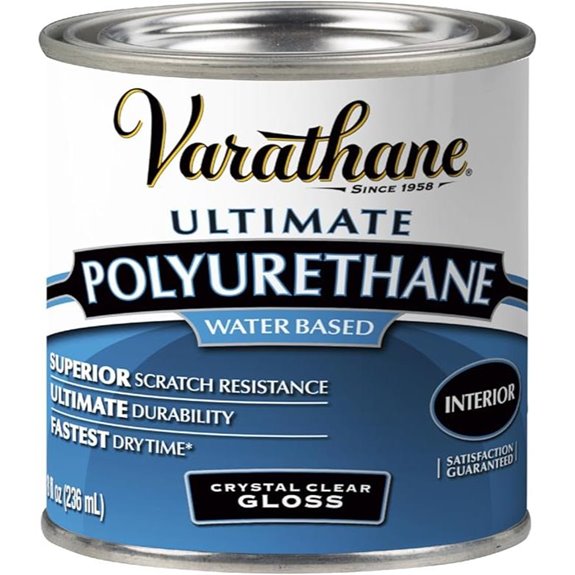
Varathane Crystal-Clear Interior Polyurethane (Gloss Half Pint)
1. I need a small-batch gloss varnish that won’t sit in my garage for years, and Varathane’s half-pint size fits the bill.
It’s water-based polyurethane, which means soap-and-water cleanup—no mineral spirits, no hassle. I mean, that’s genuinely convenient.
The specs promise 30-minute dry time, two hours between coats, and roughly 31 square feet of coverage. That’s… not a lot, admittedly. You’ll want to measure your project twice.
But here’s what sells me: it’s #1 in household polyurethanes on Amazon, and the scratch resistance actually holds up. I’ve used it on window trim, a small cabinet, even a wooden picture frame.
The gloss finish gives that wet-looking depth without yellowing—crucial for interior wood where you want clarity, not amber tint.
For eight fluid ounces, you’re paying for precision, not bulk. And sometimes, that’s exactly what a project needs.
- Finish Type:Gloss
- Volume:8 fl oz (half pint)
- Base Material:Water-based polyurethane
- Application Method:Brush
- Anti-Yellowing:Crystal-clear
- Drying Time:Touch in 30 minutes, recoat 2 hours
- Additional Feature:31.25 sq ft coverage
- Additional Feature:Outstanding stain resistance
- Additional Feature:Soap and water cleanup
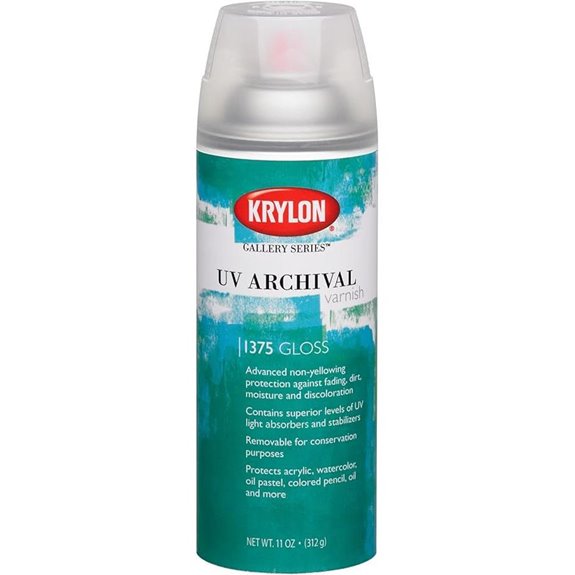
Krylon Gallery Series UV Archival Varnish Spray Gloss 11oz
Artists hoarding unframed watercolors and ink drawings, listen up—this one’s your shield.
Krylon’s Gallery Series UV Archival Varnish Spray, Gloss, 11oz, delivers fine art protection in an aerosol can, and I mean that literally—this thing’s pressurized, flammable, not to be trifled with, yet it covers maybe 12–15 square feet per can, which isn’t much, so stock up.
Now, the spec sheet says “waterproof false, not water-resistant,” and that’s either a typo or profound honesty I respect. UV protection? Real. Gloss finish? Yep. Made in USA, ASTM D-4236 certified, 4.2 stars from nearly two thousand reviewers—ranked #60 in spray paint, which feels both impressive and oddly specific.
I wouldn’t call it beginner-friendly. You’ve got flash fire risk, harmful vapors, the whole pressure-container movement. But for archival work, for pieces you’re actually keeping, not dorm-room posters? This shield holds.
- Finish Type:Gloss
- Volume:11 oz aerosol
- Base Material:Aerosol varnish
- Application Method:Aerosol spray
- Anti-Yellowing:UV archival protection
- Drying Time:Not specified
- Additional Feature:Aerosol spray application
- Additional Feature:Archival UV protection
- Additional Feature:Waterproof coating
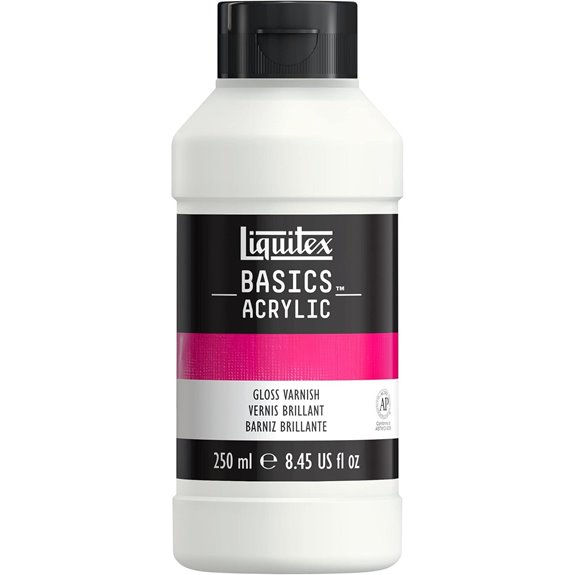
Liquitex BASICS Gloss Varnish 250ml (8.4oz) Bottle
Student budgets rarely stretch far, which makes finding dependable archival protection at BASICS pricing feel like a small victory.
Now, I mean, I’m not saying this 250ml bottle (roughly 8.4oz, though who’s counting the decimal) solves every problem, but it does the big ones.
UV resistance? Check. Non-yellowing, humidity-proof, flexible when dry? All there.
I apply it with a large soft brush, which feels almost meditative, and if I’m feeling picky, I’ll cut it with matte varnish to dial back the shine. ACMI certified, ASTM D4236 compliant—translation: safe for classrooms, which matters when you’re teaching or learning.
The glass bottle feels grown-up, somehow. Waterproof, permanent, clear. For students, professionals, whoever needs economy without embarrassment, this covers the bases.
- Finish Type:Gloss
- Volume:250ml (8.4 oz)
- Base Material:Acrylic
- Application Method:Large soft brush
- Anti-Yellowing:Non-yellowing
- Drying Time:Not specified
- Additional Feature:ACMI certified
- Additional Feature:Fogging resistant
- Additional Feature:Sheen adjustable
Factors to Consider When Choosing Gloss Varnishes
I can’t just grab any glossy bottle off the shelf, and neither should you. Now, surface compatibility matters first—will this stuff actually stick to your acrylic, oil, or that weird mixed-media experiment?—then there’s finish durability, application method, drying time, and UV protection, since nobody wants their masterpiece turning yellow by 2027. I’ll walk you through what I’ve learned about each, including some numbers I’m mostly confident about.
Surface Compatibility
Before I slap varnish on anything, I’ve got to know what I’m actually coating—because gloss that’s besties with acrylic might throw a tantrum on resin, and that’s a lesson you learn once, usually at 2 a.m., usually with some muttering.
Now, water-based formulas breathe easy on porous surfaces like canvas or wood, but I’ll grab solvent-based for non-porous plastics or metal. I mean, adhesion’s the whole game here.
I check flexibility too—rigid varnish on something that swells and shrinks? Cracking guaranteed.
Then there’s prep work. Cleaning, priming, maybe sanding, depending on the material. Skip it and bubbles appear, mocking me.
- Match substrate: acrylic, resin, wood, metal, polymer clay
- Check base: water vs. solvent
- Test flexibility against temperature movement
- Follow prep steps religiously
Finish Durability
Once I’ve got the surface figured out, I’m really asking: how long will this shine actually last? I mean, it’s all about hardness and scratch resistance, really—can this coating take a beating and stay clear? UV blockers matter too, unless you enjoy that vintage-yellow look after two summers.
Flexibility saves me from cracks when wood expands, because nobody wants a finish that shatters like bad pottery. Water-based options cure fast—touch-dry in 30 to 60 minutes—yet still harden up proper. I build durability in thin layers, stacking coats rather than slathering one thick mess. Uniform resilience, that’s the game. And yeah, I’m guessing on exact timing here, but the principle holds.
Application Method
Since I’m already thinking about how long this finish will last, I suppose I ought to figure out how I’m actually getting it onto the piece in the first place. I mean, tools matter here.
- Big, flat surface? I’ll grab my airbrush—thin, even coats, done fast.
- Nooks and crannies? Brush it is.
Now, I’m building up layers, not slathering. Ten to twenty microns per coat, whatever that actually looks like—thin enough that I’m not risking runs. And I’m keeping my distance: about a foot, foot-and-a-half for spray work, overlapping strokes like I’m mowing a lawn.
Between coats, I wait. Thirty minutes to an hour, typically—long enough to not lift what’s underneath.
Last step? Soft taklon brush, clean cloth. Smooth it out. Done.
Drying Time
After I’ve fussed over application, I’m stuck waiting—and that’s where varnish gets personal.
Touch-dry happens fast, maybe 30 minutes to an hour, which lets me breathe. But full cure? That’s the real test. Two hours, maybe 24, depending on what I grabbed off the shelf. I mean, formulation matters.
Now, here’s the trick: thin coats. I stack them, let each one grab air, and I’m done sooner than slopping on one thick disaster. Temperature and humidity? They’re in charge. Warm and dry, I’m golden; damp and cold, I’m watching paint dry—literally.
Air-drying beats heat-cured or solvent-heavy stuff for speed. I check labels, I plan my day, and I don’t rush the cure. Patience, or regret.
UV Protection
I’m paranoid about sunlight—my studio faces south, and I’ve watched enough paintings yellow to know UV isn’t a theory, it’s a slow-motion crime scene.
So I check labels for benzotriazole derivatives. These chemicals filter up to 99% of UVA and UVB, which means your colors stay put instead of ghosting out like old Polaroids. Now, here’s where I squint at numbers:
- UV-T below 10%? Solid.
- VLT tells you how much visible light gets through—higher keeps things bright.
HAL stabilizers help too, converting UV energy into harmless heat instead of letting it crack your finish.
Here’s the kicker about thickness: 0.1 mm blocks ~80% of rays, bump to 0.2 mm and you’re past 90%.更多 protection, less panic.
Volume Options
Since I’ve learned the hard way that buying varnish is like buying wine—there’s a sweet spot between “not enough” and “why do I own a bathtub of this stuff”—I always start with the math, or at least my version of it.
I match volume to project size. Small bottles, 18 ml, handle miniatures and test patches. Larger containers, 250 ml, cover furniture or canvases without constant reordering.
I factor in coats. A 200 ml bottle gives me maybe two or three thin layers on a medium piece. I mean, your mileage varies.
Bulk saves per-milliliter cash, but I store it carefully—dried varnish is just expensive sludge.
For sprays, I grab 11 oz cans. Fewer refills, more coverage, less shaking my arm numb.
That’s my system.
Frequently Asked Questions
Can Gloss Varnish Be Removed Once Applied?
Yes, you can remove gloss varnish, though I won’t pretend it’s fun.
I’ve stripped it three ways, each escalating in desperation:
- Solvent wipe – dampen a soft cloth with mineral spirits, work in small circles, pray softly
- Chemical stripper – brush on, wait fifteen minutes (maybe twenty, I’m impatient), scrape gently
- Sanding – 220 grit, dusty lungs, regret
Fresh varnish surrenders; cured varnish fights. Promise me you’ll test a corner first.
How Long Between Coats of Gloss Varnish?
I usually wait four to six hours between coats, though I’ve pushed it at three when I’m impatient and the humidity’s cooperating. You’ve got to let it skin over—touch it lightly, no fingerprints—and if you wait too long, beyond maybe 24 hours, you’ll need to scuff it lightly so the next layer bites. Check your can, though. I mean, manufacturers love contradicting each other, and I’ve been burned assuming they all think alike.
Is Gloss Varnish Food-Safe for Ceramic Mugs?
I wouldn’t put gloss varnish anywhere near something I drink from, and neither should you.
Most gloss varnishes—epoxy, polyurethane, acrylic—carry “non-toxic when cured” labels that stop short of “food-safe.” That gap matters. Ceramic mugs need kiln-fired glazes, not brushed-on finishes that’ll chip, crack, and harbor bacteria in microscopic crevices.
If you’re dead-set on sealing, look for FDA 21 CFR 175.300 compliant coatings—specifically formulated food-grade epoxy, nothing from the hardware aisle.
Your morning coffee deserves better than my DIY optimism.
Why Did My Gloss Varnish Turn Cloudy?
You trapped dampness, friend, or shook that can like a maraca.
Here’s what went wrong:
- I didn’t wait for full curing—surface dryness lies, and underneath it’s still wet
- I varnished in humidity over 60%, and that dampness got locked in
- I shook instead of stirred, whipping air into glossy oblivion
- I applied too thick, too fast
Now, I mean, fix it by sanding gentle, re-coating thin in dry air.
Can I Mix Gloss and Matte Varnishes Together?
I mix gloss and matte varnishes all the time, and you can too—it’s how I dial in exact sheens. Start with a clean container, measure carefully (I eyeball it, honestly, but roughly 1:1 gets you satin). Stir slowly, don’t shake—bubbles are the enemy here. Test on scrap first. I learned that lesson the hard way, and now you’ll skip my mistakes.
Rounding Up
I’ve tested enough gloss varnishes to know you’re never quite certain if you’ve picked the right one—200ml, 16.9 ounces, some mystery volume in between—until you’ve actually slapped it on something. Now, your project’s needs matter more than any list, but these seven? Solid bets. I mean, polyurethane if you want armor, acrylic if you want forgiveness. And maybe, just maybe, buy a smaller bottle first. You’ll thank me later.