What Are White Spirits? Types, Uses and How to Choose

If your brush cleanup or primer sanding feels off, the white spirits you grab may be the culprit. They are not one product, and the type number alone will not tell you what is inside.
This guide covers their types, uses and how to choose, so you can match solvent to paint, drying time, and surface prep. You will see how flash point, distillation range, and aroma affect results, plus when a low odor grade makes sense.
Get it right and you avoid tacky coats, slow cure time, and finish failures. Let’s unpack the details next.
Quick Answer
- White spirits are petroleum solvents used for thinning paint, cleaning brushes, and degreasing.
- Types include Stoddard solvent, mineral spirits, and turpentine substitutes with varying aromatic content.
- Aromatic content determines toxicity, odor, VOC levels, and drying speed; lower aromatics mean safer use.
- Choose flash point grades based on storage conditions: higher flash points reduce fire risk and fume buildup.
- Verify label specs like flash point, distillation range, and VOC content; use Certificate of Analysis for batch approval.
What Exactly Are White Spirits?
White spirits are the petroleum solvent many of us keep near the paint shelf and call paint thinner.
White spirits are the petroleum solvent many of us keep near the paint shelf and call paint thinner.
The cans can contain Stoddard solvent, mineral spirits, or turpentine substitute, and the exact mix changes from batch to batch.
That mix matters because aromatics often make up 15 to 20 percent of the product, dissolve paint faster, and raise toxicity; paraffins dry more slowly and change your recoat time.
Check the label for flash point, boiling range, and VOC content before you use the product on a primer, stain, varnish, or polyurethane finish.
A stronger solvent can lift dried paint from brushes and speed cleanup, but it also sends more fumes into your shop.
Spread a drop cloth, tape off trim with painter’s tape, open the windows, and keep your brush strokes inside the wet edge so lap marks do not show in the topcoat.
For a gloss, satin, or matte sheen, test the solvent on a scrap board first and watch both drying time and cure time.
Match your sanding grit and application method to the product, then use the same grade from start to finish so the finish behaves as expected.
Higher flash points, such as the 144°F found in purified professional solvents, make accidental ignition harder and create a safer working environment.
Why White Spirit Type Numbers Are Misleading
White spirit type numbers (Type 0, Type 1, Type 2, and Type 3) can look like a shortcut. They do not tell you enough about aromatic content, and that is where a finish batch can go wrong.
Type 0 and Type 1 often carry 15 to 20 percent aromatics. Type 2 and Type 3 stay below one tenth of one percent, so the numbers do not form a straight scale.
Type 0 and Type 1 can also overlap in specs from one refinery to the next. Aromatic content alone will not sort them out, and the type label hides that overlap.
White spirit is often used to thin varnish or polyurethane and to wipe down a surface before primer or topcoat. If the solvent changes the drying time, you can get brush strokes, lap marks, or a poor wet edge on the next coat.
Ask for the Certificate of Analysis and check flash point, distillation range, and aromatic content by weight. Use those numbers to approve the batch before you open a can.
Keep painter’s tape and a drop cloth nearby, and match your sanding grit to the surface before you apply stain, primer, or topcoat. Let the solvent flash off fully and respect both drying time and cure time, especially on jobs with VOC limits or a satin or matte sheen.
For oil-based paints and varnishes, a low-odor mineral spirits can help preserve pigment integrity while cleaning brushes with minimal residue.
Comparing White Spirit Grades: Flash Point, Distillation, Aromatics
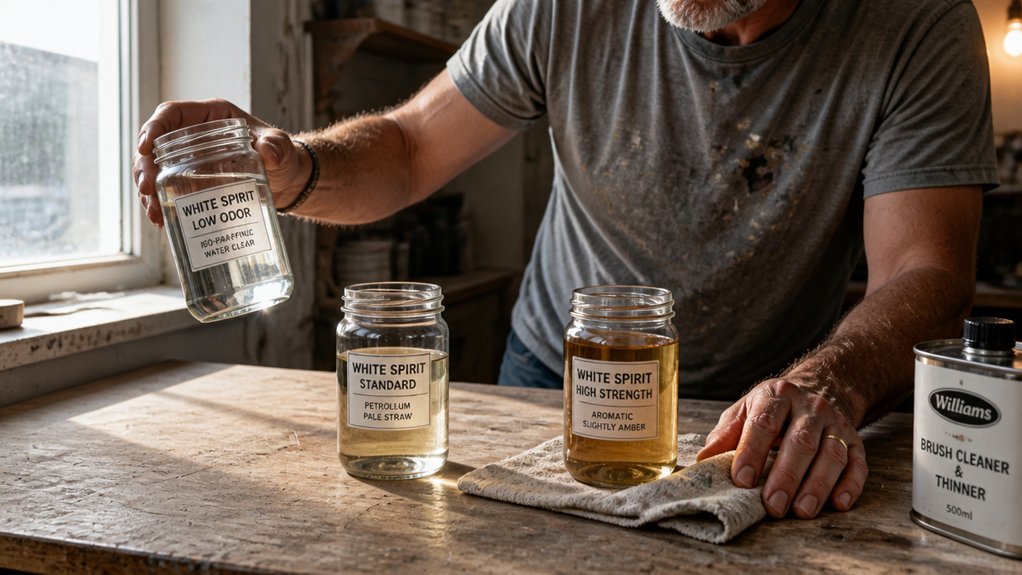
When you pick up a can of white spirit for a finishing job, check two label numbers first: flash point and aromatic content. Flash point tells you how safely you can store and pour the solvent near a primer or topcoat, and it shapes how you handle rags and open containers. Denatured ethanol is a distinct solvent that also requires checking its proof and denaturant composition for safe and effective use. A high aromatic grade has a stronger smell and can add to VOC concerns when you are sealing stain with varnish or brushing polyurethane in a small room. If odour bothers you or your shop has strict VOC limits, pick a lower aromatic grade, lay a drop cloth, and tape off edges with painter’s tape before you open the can.
Use the same white spirit to wipe up dust after a 120 or 180 grit sanding pass, and check for lap marks and brush strokes before the wet edge closes. Drying time and cure time matter when you choose a gloss, satin, or matte sheen for the topcoat, so let the solvent flash off fully and wait for the cure time before you sand or recoat.
Flash Point Specifications
When you compare white spirit grades, the flash point is the practical safety and storage spec that matters most. It sets the flammability hazard and storage class, so a wrong choice can bring regulatory trouble or a real fire risk.
For brush cleanup between sanding grits, or for thinning varnish and polyurethane, use the grade that fits your shop temperature and ventilation. A solvent that flashes off too fast can shorten your wet edge and leave lap marks or brush strokes in a gloss or satin topcoat.
Grade 30 has a flash point around 28°C and sits in Class B, so treat it with real care. Grade 40 has a flash point around 42°C, which eases transport rules but still needs a cool, ventilated space.
Grade 80 has a flash point around 80°C and feels almost forgiving in warmer workshops. Keep primer, stain, and clear finish work away from open flames, and use a drop cloth with painter’s tape to control drips.
Sheen choice, whether gloss, satin, or matte, is separate from flash point; VOC rules and drying time versus cure time still affect how you store and use the solvent. Match the flash point to your shop conditions and the way you work, because I learned that the hard way once with a warm shed. Low VOC eco-friendly formulas keep indoor air breathable, which matters when you’re brushing or spraying in a garage with limited ventilation.
Aromatic Content Limits
Every grade I have tested above Type 0 has a catch. The aromatic content can swing from 14% to 27% by weight.
That number affects the odor, your VOC compliance, and whether the primer and topcoat stay clear or turn yellow. Do not choose a grade by its type number and assume the aromatics are low.
Ask your supplier for an EN 13725 or ASTM D1319 test report before you buy the stain, varnish, or polyurethane. Check the local VOC emission limits first because the rules in the EU get tighter every year.
Write the maximum aromatic content by weight on your order and keep a copy with the product data. On the job, use the right sanding grit, keep a wet edge, and watch your brush strokes so the finish lays out even.
A satin or matte sheen can hide small flaws better than gloss, but a clear topcoat still needs stable aromatics. Respect the drying time and the cure time, and set out a drop cloth and painter’s tape before you open the can. When working in enclosed spaces, use a NIOSH-approved respirator with organic vapor cartridges to guard against solvent fumes.
Choose the Right White Spirit for Your Application
Picking a white spirit by price alone can ruin a finish or break safety rules. Start with the grade: use a low odor grade for brush cleaning and general shop work, and use a high flash grade only when the product label calls for it.
Then check the aromatic content on the safety data sheet. A low aromatic white spirit smells milder and is safer indoors, and a high aromatic solvent cuts heavy varnish and polyurethane faster.
For paint and finish work, match the solvent to the product. If you thin an oil based primer or topcoat, follow the label and add small amounts so the sheen and drying time stay predictable.
Drying time tells you when you can recoat, and cure time tells you when the film is fully hard. Aromatic limits matter because high aromatic solvents raise VOC exposure and can soften some finishes, so keep the shop ventilated and wear the gloves and respirator listed on the safety data sheet. Wet film thickness checks before curing can also reveal uneven solvent application that leads to weak spots.
Lay a drop cloth and tape edges with painter’s tape before you open the can. Sand between coats with the sanding grit your finish maker recommends, and keep a wet edge on stain, varnish, and polyurethane to avoid lap marks and brush strokes.
Pick the sheen before you start: gloss shows flaws, satin hides small marks, and matte softens the look. Follow those steps and your solvent will do its job without wrecking the finish or your shop air.
Grade Selection Criteria
Pick white spirit by matching three numbers to your shop and your finish. Match the flash point to your safety setup, the distillation range to your drying time, and the aromatic content to your odor tolerance.
Flash point tells you how hot the solvent can get before it gives off enough vapor to ignite. Match that number to your ventilation, heat sources, and spray area.
Distillation range tells you how fast the solvent leaves the film. A tighter range gives you more repeatable drying time, which helps you plan your recoat window.
Aromatic content affects smell and VOC level. Pick a level your nose and your shop ventilation can handle, then test it on a small panel before you commit to a full topcoat.
You may use white spirit with primer, stain, varnish, or polyurethane, and your sheen choice can run from gloss to satin or matte. Lay your drop cloth and set painter’s tape, then check the label for drying time and cure time before you start.
Choose your sanding grit and prep the surface before you open the white spirit. Keep a wet edge while you brush so you do not leave lap marks or heavy brush strokes.
Ask for the batch test sheet, often called a certificate of analysis, with every delivery. Keep one copy for each lot so you can catch a change before it shows up as a dull sheen or a soft topcoat.
Check how the supplier controls quality and what they do when a batch fails. One cheap drum of bad solvent is no bargain if it ruins your finish.
Get the flash point and distillation range in writing before you buy. Make the supplier prove each batch meets those numbers, because the grade name alone will not protect your finish.
Write down the flash point and distillation range you need, then make every delivery meet that sheet. Keep that sheet with your job notes and check every delivery against it.
A quick check before you pour saves you from a bad batch on a topcoat. Check the batch sheet before you open the can, then stir and test on a scrap panel.
For faster coverage on large surfaces, consider pairing your solvent choice with an airless sprayer rated at 3000 PSI or higher to handle thick coatings without thinning.
Specifying Aromatic Limits
Aromatic content in a finish or solvent is the share of benzene ring compounds it contains, and it affects smell, air quality rules, and worker exposure. A gas chromatography test on each batch gives the exact wt% of those compounds, so you know what you are spraying or brushing.
Do not trust the type number on the label to tell you the aromatic level. Type 1 can still arrive high, and a verbal “low aromatic” claim is not enough for a primer, varnish, or polyurethane job.
Write a hard maximum in the purchase order, such as 18 wt%. That gives the supplier a clear number to meet and gives you a record for VOC compliance.
For indoor coatings and food contact surfaces, set the limit at 0.1 wt% or less and ask for a dearomatised cut, which means a low aromatic solvent. For general degreasing, 20 wt% or less can work and may save about 15% per litre.
Aromatic solvents also change how a stain or topcoat flows, how the wet edge holds, and how gloss, satin, or matte sheen develops. They can affect brush strokes, lap marks, drying time, cure time, and the way sanding grit cuts the next coat, so check the CoA before you open the can. Get the CoA for each batch and test the first drum before you lay out the drop cloth or set painter’s tape. Put the limit in writing and keep the test record with the job papers. For thorough blending of your test batch, ensure your equipment provides the uniform mixing results that prevent clumps and settle inconsistencies from skewing your coating checks.
Where White Spirits Are Used: What It Means for Your Choice

White spirit matters because you need to know where it will do the job and where it will cause trouble. Match the solvent to the task you are doing, then choose a grade that fits your space and your safety needs.
White spirit matters because knowing where it works—and where it fails—saves your finish and your safety.
When you spray primer, color, and topcoat, the solvent has to support a wet edge and a drying time that lets you avoid lap marks. In a spray booth or a small shop, check VOC content and ventilation before you set your drop cloth and pull painter’s tape. Cleaning kits with stainless-steel picks and non-shedding nylon brushes help remove dried paint from nozzles and fluid passages between coats.
When you clean brushes after varnish, polyurethane, or stain, you want a solvent that cuts the finish without leaving a sticky film. Brush strokes and sheen show more in gloss than in satin or matte, so sanding grit and surface prep matter as much as the solvent.
High aromatic grades can push you past exposure limits, so ventilation becomes a required part of the job. A sticky film after drying usually points to aromatics left behind in the mix, and a low aromatic grade can cut odor complaints from workers or neighbors.
For workplace safety, choose a high flash grade such as White Spirit 60 to reduce fire risk and fume buildup. Match the flash point to your process temperature, then match the aromatic level to the smell you and your crew can live with.
If you are applying a topcoat, keep drying time and cure time separate in your schedule. Use the right sanding grit, and keep your drop cloth and painter’s tape clean so stray grit does not land in the finish.
When to Use Dearomatised Solvents Instead of White Spirit
Dearomatised solvents are for jobs where smell, worker exposure, or local rules matter. If you are coating a child’s toy or painting inside a small room, the strong sweet smell of ordinary white spirit becomes a problem.
That is when you choose a dearomatised solvent for your primer, topcoat, stain, varnish, or polyurethane. These fluids have aromatics, the smelly and reactive hydrocarbon molecules, at less than one tenth of one percent by weight, while white spirit is around twenty percent.
You also need them when rules limit VOC emissions or when worker exposure limits are tight. Use them for coatings that touch food, odour sensitive adhesives, or clean room degreasing.
They cost about 15% to 20% more and dry a little faster. They have less solvency for heavy resins, so test your mix before you commit a whole batch.
For a wood finish, check how the solvent affects sheen, gloss, satin, or matte results before you spray or brush. A drop cloth and painter’s tape keep your work area clean, but they do not fix poor ventilation.
When you sand a stained or varnished piece, use the right sanding grit and watch for lap marks and brush strokes. Keep a wet edge on large panels, and check drying time before you handle the piece and cure time before you stack or use it.
If your mix tolerates the change, you get a safer, cleaner product for the people who handle it. Switch when regulations or the final use call for it, and ignore a fancy supplier brochure. Avoid adding too much of any additive, as excess may affect color intensity or drying time.
How to Specify White Spirit for Consistent Supply
I have finished cabinets, trim, and furniture for years, and white spirit trouble usually starts with a loose spec or a supplier who changes the blend. A clear spec and a certificate of analysis on every delivery will save you a lot of grief.
Ask for three things in writing and keep them on the purchase order. First, set a minimum flash point so you know how to store the solvent and meet safety rules.
Second, set the distillation range from initial boiling point to final boiling point. That range controls how fast the white spirit evaporates, which helps your primer, stain, varnish, or polyurethane keep a steady drying time and wet edge.
A steady wet edge helps you avoid lap marks and heavy brush strokes when you work a topcoat. Third, set a maximum aromatics content so the smell and VOC levels stay predictable.
Those three numbers give you a baseline for batch consistency, whether you spray, brush, or wipe a stain. Then demand a CoA for each lot and check that the numbers match your spec.
Supplier audits are dull work, but they catch careless blending before it reaches your shop. Without a CoA and an audit, you are guessing how the next can will behave under your brush or spray gun.
A tight spec plus audited suppliers removes one more variable from your finish schedule. That means fewer surprises with drying time versus cure time, and a better chance of getting the sheen you want, whether that is gloss, satin, or matte.
Keep a drop cloth down and painter’s tape on hand while you test each new lot on scrap wood. Use the same sanding grit and the same brush or spray setup so you can judge the white spirit fairly.
Write the flash point, distillation range, and aromatics limit into your spec, then check every delivery against it. That habit keeps your primer, topcoat, and clear finishes more consistent and gives the paperwork a real job.
Frequently Asked Questions
Can White Spirit Expire or Degrade During Storage?
White spirit can degrade during storage, but it does not truly expire. Its shelf life depends mainly on a sealed container and cool, dark conditions that limit evaporation and oxidation.
For a quick check, place a few drops on clean glass and let them flash off for 10 minutes. If a sticky film remains, do not thin your finish with it.
Store the can tightly closed and label the fill date; use older mineral spirits first. I would still test a small batch before critical work, especially if the liquid looks cloudy or smells sour.
Is White Spirit Safe to Use Indoors With Ventilation?
White spirit can be safe to use indoors with ventilation, but treat it as a short, controlled job rather than a lingering solvent session. You need cross flow, because fumes can hang around after the smell fades.
As a painter, I would open two windows, put a box fan blowing outward in one, and keep the room closed off from children and pets. For a small brush cleanup, pour used mineral spirits into a sealed jar, wipe the brush, and cap the jar within 15 minutes.
Keep exposure short, take fresh-air breaks, and never assume a faint odor means the air is clear. If the task needs more than a quick touch-up, move it outside or use a lower-solvent product.
What Is the Difference Between White Spirit and Mineral Turpentine?
White spirit and mineral turpentine are both petroleum-based solvents, and in many regions mineral turpentine is simply the local name for white spirit, while true turpentine is distilled from pine resin. They behave similarly for thinning and cleanup, but mineral turpentine often has a stronger odor and faster evaporation.
For brush cleanup, use the product labeled for your coating and check the SDS before switching brands. A practical rule is to test a small patch and confirm compatibility, because “mineral turpentine” can mean mineral spirits in Australia and New Zealand. Ventilate well and avoid mixing solvents; store each in a labeled container.
Can White Spirit Be Recycled or Reused After Cleaning Brushes?
Yes, white spirit can be recycled and reused after cleaning brushes. Let the used spirit settle in a sealed jar for 24 hours, then pour off the clear top layer for general cleanup.
Keep the sediment-rich bottom portion for a final brush soaking before disposal. This simple settling routine stretches every drop and reduces waste.
For a related search, look up mineral spirits recycling, since it is the common US name for white spirit. Store the reclaimed liquid in a clearly labeled container and use it for tool cleanup or preliminary rinses, not for fine finish work.
Are There Food-Grade or Pharmaceutical-Grade White Spirits Available?
No, food-grade white spirit is not available, and pharmaceutical-grade white spirit is not a standard product; pharmaceutical work uses dearomatised solvents under stricter standards. Regulators do not approve ordinary white spirit for food contact because of its toxicity profile, so do not substitute it for a food-safe solvent.
For a practical check today, read the label and safety data sheet, then let a solvent-wet test offcut flash off for 24 hours before you judge odor or recoat. If you need a dearomatised solvent, confirm the batch certificate and intended use with your supplier.
For brush cleaning, keep a separate labeled container of ordinary white spirit and never use it on food-contact surfaces.
Rounding Up
To choose white spirits, match the solvent to the job by evaporation speed, not the misleading type number. Check the label for low aromatic content and a high flash point before you buy for painting.
Compare cheap mineral spirits for degreasing and dearomatised solvent for indoor work. Test a small batch first and ask the supplier to explain any jargon.
Keep regular white spirit for the garage and save your sanity and wallet. Do not overthink the chemistry degree talk about flash points, distillation curves, and aromatics.
Read next about distillation curves.